


Post Single
Posted by:
Comments:
Post Date:
Introduction: Why External Audit Preparation Matters
Instead of viewing external audits as strategic opportunities, organizations frequently view them as sporadic disturbances. This way of thinking raises the possibility of non-compliance and causes needless tension. On the other hand, a well-prepared audit increases stakeholder confidence, enhances transparency, and fortifies internal controls. As industry-wide regulatory scrutiny increases, audit preparation becomes an ongoing activity rather than a one-time endeavor. Businesses that make structured preparatory investments not only pass audits more easily but also identify risks and inefficiencies early on. This article provides professionals managing audit preparedness with a grounded and useful viewpoint by examining useful checklists and highlighting typical hazards.
Building a Robust Audit Preparation Checklist
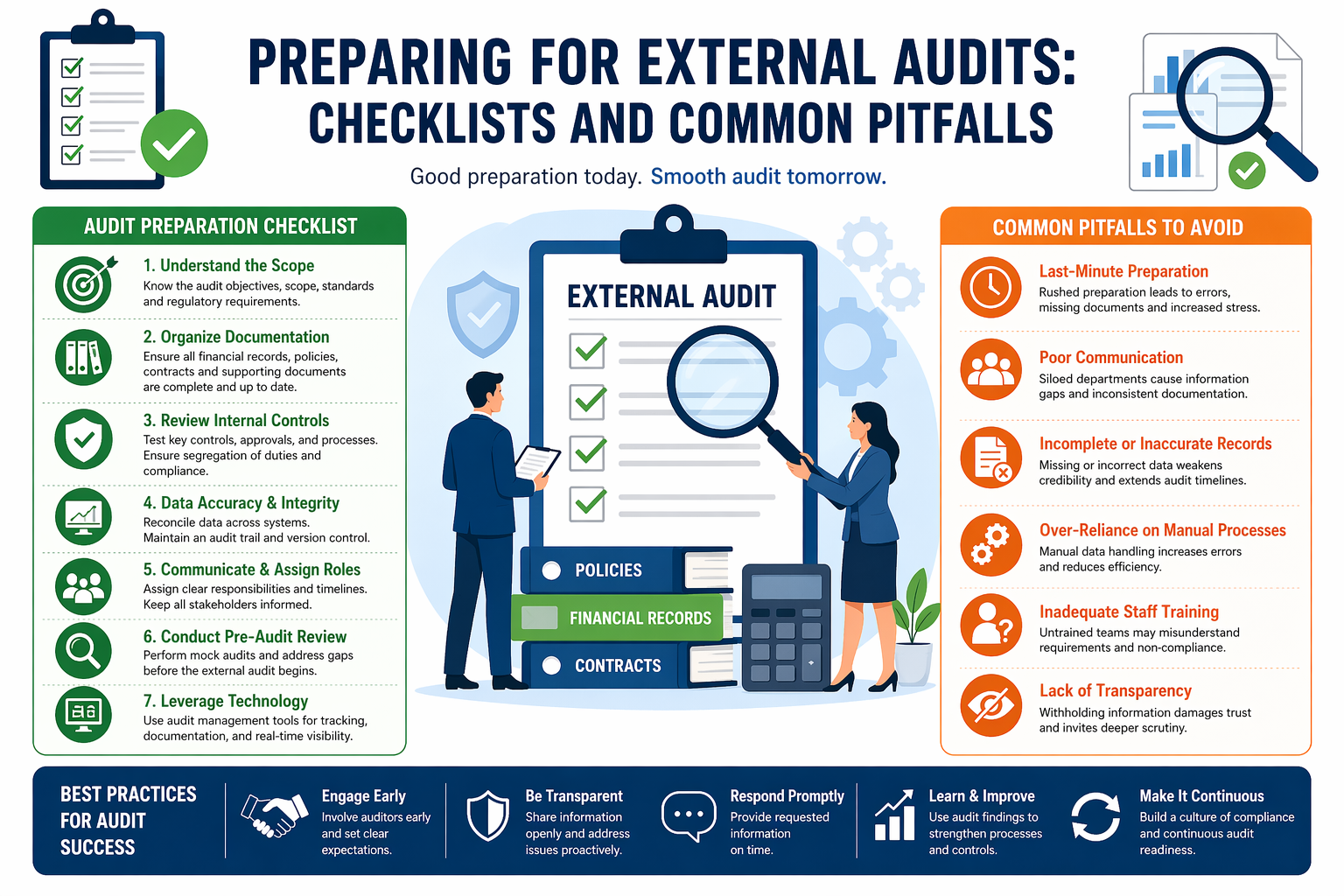
The foundation of a successful audit preparation process is an organized checklist. Organizations should start by outlining the audit’s scope precisely, taking into account operational benchmarks, financial standards, and legal obligations. Teams can more effectively assign resources and prioritize projects thanks to this transparency. Next, businesses need to make sure that all policies, supporting documentation, and financial records are current, correct, and readily available. Disorganized documentation frequently delays audits and raises concerns for auditors.
Teams should thoroughly review internal controls before the audit starts. Teams need to confirm that compliance procedures, segregation of roles, and approval workflows operate as planned. Internal mock audits can mimic actual audit situations and identify shortcomings that could otherwise go undiscovered. In order to ensure responsibility throughout the planning phase, corporations should also provide team members specific duties. Leadership must coordinate all departments with audit goals and schedules since communication is essential.
Checklist execution can be greatly improved by technology. Contemporary audit management technologies monitor compliance, simplify documentation, and offer real-time insight into audit preparedness. Organizations can decrease last-minute scrambling and increase overall efficiency by incorporating these tools into regular operations. In addition to directing preparation, a well-kept checklist boosts team confidence.
Documentation and Data Integrity: The Cornerstone of Audit Success
Any successful external audit starts with accurate documentation. To verify financial statements, operational procedures, and compliance adherence, auditors mostly rely on written evidence. Records must be accurate, consistent, and compliant with regulations. Even little differences can lead to more thorough examination and longer audit durations.
Data integrity include uniformity across systems and reports in addition to correctness. When data from many departments is inconsistent, it can cause confusion and damage a company’s trust. Organizations should create standardized reporting formats and centralized data management solutions to address this. Inconsistencies can be further reduced by routine data reconciliation procedures.
Data integrity includes uniformity across systems and reports in addition to correctness. When data from many departments does not match, it can cause confusion and damage a company’s trust. Organizations should create standardized reporting formats and put in place centralized data management solutions to handle this. Inconsistencies can be further reduced through routine data reconciliation procedures.
Common Pitfalls That Undermine Audit Readiness
Many firms encounter obvious pitfalls when preparing for audits, even with meticulous preparations. Last-minute planning is one of the most frequent mistakes. Teams frequently put off audit readiness tasks until the last minute, which results in hurried procedures and missed details. This reactive strategy lowers overall audit performance and raises the possibility of mistakes.
Inadequate departmental communication is another common problem. Finance, operations, compliance, and IT teams must work together to conduct audits. Critical information may not flow efficiently when various groups work in isolation, leading to inconsistent or inadequate documentation. To guarantee alignment and transparency, organizations must promote cross-functional communication.
Over-reliance on manual procedures also creates significant difficulties. Manual data entry and tracking slow down preparation and increase the likelihood of human error. Businesses that don’t use automation solutions frequently have problems with accuracy and efficiency. Inadequate staff training can also result in misconceptions about audit needs, which makes the process much more difficult. For employees to effectively contribute to audit readiness, they must be aware of their duties and responsibilities.
Managing Auditor Relationships and Expectations
Businesses frequently undervalue how crucial it is to have positive working relationships with external auditors. Both parties’ audit experiences can be greatly enhanced by working together. Businesses should involve auditors as soon as possible, outlining standards for paperwork, deadlines, and expectations. Misunderstandings are avoided and uncertainty is decreased by this proactive communication.
In order to manage auditor relationships, transparency is essential. Even while dealing with possible problems, organizations should give accurate and transparent information. Trying to hide issues might undermine credibility and result in closer examination. Rather, businesses should show that they are prepared to fill up the gaps and take corrective action.
Prompt responsiveness also influences audit results. Delays in providing required documents or explanations disrupt timelines and create frustration. Assigning a dedicated audit coordinator improves communication and ensures teams respond quickly to requests. Organizations may change audits from hostile procedures to positive engagements by cultivating a transparent and cooperative partnership.
Leveraging Continuous Improvement for Future Audits
After the audit is finished, planning should continue. Businesses that view audits as educational opportunities benefit in the long run. Teams can find opportunities for growth as well as strengths and shortcomings through post-audit assessments. These observations can improve overall compliance frameworks and guide future tactics.
Integrating audit results into routine operations is necessary for continuous improvement. Based on audit feedback, businesses should revise policies, improve procedures, and fund training initiatives. This proactive strategy increases organizational resilience and lessens the possibility of reoccurring problems. Furthermore, establishing an accountability culture guarantees that audit preparedness remains a continuous goal rather than a one-time assignment.
Once more, technology is essential to maintaining progress. Compliance data can be tracked and trends can be found over time using sophisticated analytics and reporting technologies. Organizations can foresee possible dangers and take action before they worsen by utilizing these insights. Audits become strategic drivers of operational excellence through continuous improvement.
Conclusion: Turning Audit Preparation into a Strategic Advantage
External audits are now opportunities to improve organizational performance and boost governance rather than just being compliance checkpoints. Businesses that prioritize data quality, use organized checklists, and steer clear of typical traps set themselves up for more seamless audit experiences. Good communication improves results and fosters trust, both internally and with auditors.
Instead of seeing audit preparation as a last-minute endeavor, the most prosperous companies see it as a continuous process. They transform audits into strategic advantages by adopting continuous improvement and integrating audit readiness into daily operations. This proactive strategy guarantees compliance and promotes long-term success in an increasingly data-driven and regulated company environment.
