


Post Single
Posted by:
Comments:
Post Date:
Introduction
Remote management is becoming an increasingly practical model for self-storage operators. Technology can enable a management team to oversee multiple facilities without requiring a full-time employee at each location. Industry discussions on remote management highlight technology, security, maintenance, and operational oversight as key considerations when reducing onsite staffing.
But managing a site remotely creates a different operational challenge: how do you know what is actually happening at the property when your team isn’t there?
Teams can mark tasks complete, submit inspections, and report problems, but management still needs confidence that the work happened as expected. Remote and unmanned self-storage facilities need workflows that build accountability instead of relying on manual follow-ups.
Key Points to Remember
- Verify that site audits are actually being performed onsite.
- Use location-based controls to strengthen accountability.
- Monitor new, in-progress, and completed tasks from one dashboard.
- Compare audit scores across locations and against previous results.
- Turn operational data into a clear view of portfolio performance.
The Challenge of Managing an Unmanned Site
Remote operations do not eliminate the need for physical inspections, maintenance, and oversight. In fact, they make reliable verification more important. A manager may see that an auditor completed an audit, but that does not confirm they were physically at the facility.
This is where digital audit controls can make a meaningful difference. NIST guidance on audit and accountability emphasizes recording details such as what happened, when it happened, where it happened, and who was involved. It also recommends reviewing audit records to identify unusual activity and support organizational awareness.
For self-storage operators, applying that principle to site inspections means creating a stronger connection between the digital record and the physical location.
Verified On-Site Audits with SiteWare
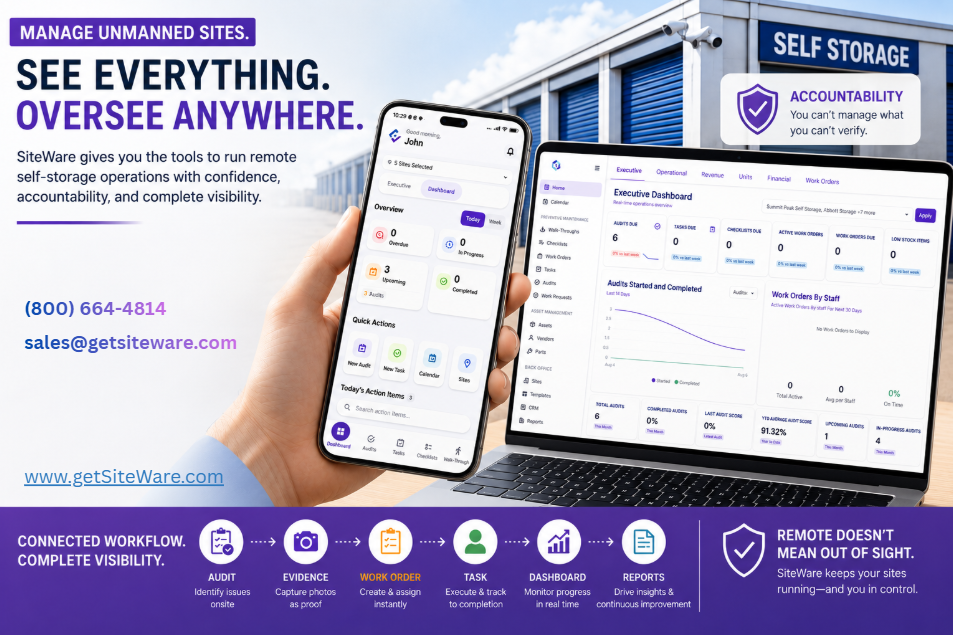
SiteWare helps address this challenge with geo-location verification for audits. When an auditor performs an inspection, the platform can capture a location stamp associated with the audit. Management can therefore confirm that the inspection took place at the expected site, rather than simply receiving a completed checklist.
SiteWare also introduces a Geo-Location Audit Lock. When enabled, the system requires auditors to be physically onsite before starting an audit. This adds accountability by preventing auditors from starting inspections remotely and completing them later as if they were onsite.
The distinction matters. A timestamp shows when an auditor completed an audit, while location data shows where they performed it. For remote operations, combining these details creates a more reliable audit record.
One View of Remote Operations
Verification is only one part of remote management. Managers also need a clear understanding of what is happening across their portfolio.
SiteWare dashboards provide visibility into new, in-progress, and completed tasks, giving management a centralized view of operational activity. Instead of contacting individual team members or checking separate spreadsheets, managers can quickly see what requires attention and where work stands.
This is particularly useful when one team is responsible for multiple facilities. A centralized dashboard helps managers identify workloads and outstanding tasks, so they can focus on locations that need attention.
Compare Site Performance, Not Just Activity
A list of completed audits tells management what was done. Audit scores provide a better indication of how a site is performing.
SiteWare makes site audit scores visible so management can compare one facility against another using consistent audit criteria. This can highlight locations that are performing well and identify sites that may need additional attention, training, or follow-up.
Historical comparison is equally important. A site does not always need to be compared with another facility to reveal a problem. Comparing its current audit score with its previous score can show whether performance is improving, declining, or remaining consistent.
This creates a more useful performance conversation: not simply “Was the audit completed?” but “What does the audit tell us about this site’s performance, and is that performance changing?”
Turning Remote Management into Accountable Operations
The strongest remote operating model connects verification, task management, and performance measurement. An issue found during an audit can create a corrective task, while management tracks progress through the dashboard and evaluates site improvement.
That closed-loop approach reduces the gap between identifying an issue and knowing whether it was resolved.
For unmanned or multi-site self-storage facilities, the goal is not to recreate on-site management remotely. It is to ensure management gets the right information at the right time to make confident decisions.
Conclusion
Remote self-storage operations require more than remote access to software. They require visibility, verification, and accountability.
SiteWare brings these elements together through geo-location-stamped audits, the optional Geo-Location Audit Lock, centralized task dashboards, and site audit score comparisons. These capabilities help management verify that inspections are happening onsite, understand what work is currently taking place, and compare facility performance across locations and over time.
For operators managing lean, unmanned facilities, that level of visibility can turn remote management from a question of uncertainty into a more structured and measurable way of operating.
